The Role of Faith in my PhD Research

Faith is central to me. This stems from a background deeply rooted in the belief of there being more to life than what my natural eyes see. Living, experiencing and exploring the world have constructed the manner in which I approach situations, experiences and ideas.
It is an essential element of my life because it carries within it, a demonstration of how I ought to go about living – dashing across professional and societal aspects, to the most ordinary of practises and rituals within the everyday life of Emmanuel. It characterises my lifestyle, orders my steps and motivates me to improve upon myself.

As I am an individual of faith, looking into how faith helps international students navigate their studies, I realise this would undoubtedly shape the way I approach my PhD research. My perspective is centred on my background as a Christian Nigerian man looking into ways of life different to mine. In addition to that, I am one who has experienced substantial cultural refinement, having studied in diverse UK campuses since 2012, learning and unlearning some presuppositions. Thus, my standpoint diverges against its own self. My interaction with others, and thus considerations about research design, including data collection methods must be undertaken with empathy, tolerance and understanding – bearing in mind at all times that cultures present people with different ways of perceiving the world – ways unique to them, and them alone.

The focus, therefore, is on my ability to use my background in exploring others efficiently; researching and critiquing, in order to draw up findings impactful and true to myself and others.

I am interested in exploring how faith contributes to the academic experience of international students. In this, my faith shall act as an avenue for me to explore identity and difference, zooming in on the reality of being an international student of faith in British Higher Education.

As a result of my faith, I am mindful of difference in viewpoints between my participants and me. I am more than willing to maintain researcher integrity; by being non-judgemental about other perspectives and acknowledging feelings and opinions contrary to mine.

As I undertake this research, the question for me becomes: how can my faith guide, inspire and contribute to my research output?


What is Happiness?

DH new.jpg

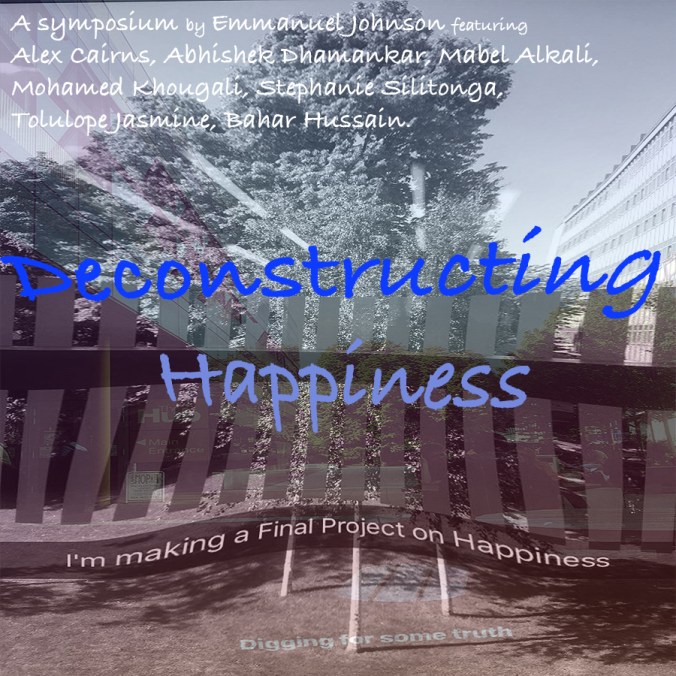
I gathered a group of intellectuals and thinkers, across cultures and disciplines to discuss happiness. I was interested in seeing how such vast and complex discourse could be perceived in several ways. This symposium was recorded as sound. Please see links below to listen:


Stream

Happiness Research Journal V: Narrowing Down on Documentary Topic

At the moment, it has solidly been established that I want to explore the topic of happiness, whilst focusing on affect, and looking into the feeling of mutuality experienced by International students within small groups of collective interests. Nonetheless, I am struggling to pinpoint a narrow topic for the documentary that I intend to produce, which I hope captures the emotions I feel; as a member of the populace of international students.

My struggle is very much focused on the fact that, I have feelings and emotions which embody the focus of what I aim to produce. Every day as I go out and interact with international students, I experience these affects; very strong feelings of ‘togetherness’ which bind international students together and enable us function as a unit. However, I am unable to convert them into something denotable, which can be used in developing a message or narrative of some sort, needed for the picture I intend to capture in this project.

My strategy for tackling this obstacle thus far has been research. I have been reading into, and exploring the theory of ‘affect’, with hopes of gaining a better understanding of it, which I believe would make my journey a little less burdensome. Nonetheless, this is yet to provide me with the enlightenment that I seek.

My ‘search of meaning’ is exposing me to extensive frameworks of feelings; which are now generated during social encounters with international students from countries and cultures foreign to mine.

The so called ‘feeling of mutuality’ which I have touched on in previous posts is becoming manifest to me, even whilst socialising and ‘chilling’ with individuals from a different country (Indonesia), who speak Bahasa Indonesia which I do not understand. Nevertheless, I am able to experience similar feelings of togetherness as them, whilst under the same umbrella of vibrations created by the affective atmosphere of trust and intimacy built by these foreigners. This has me arriving at an epiphany and thinking to myself ‘wait a minute! You mean to tell me that, the feeling of mutuality isn’t experienced solely within national communities, but back and forth with international and vice-versa?’.

This highlights infinite potential experiences which other international students might have faced; crucial to my research but new to me still.

This complex experience leaves me with multiple questions, such as:

  • What does that experience really mean?
  • How is that affective experience even created?
  • Why do I share the same emotional attachment as them, although I do not understand the language that they speak, or their mannerisms and way of life?
  • Do other international students connect to umbrellas of vibration, generated by people from countries foreign to them?

I believe that, within these questions, I shall find solutions to many of the puzzles I have battled with, whilst deciding on my documentary topic. I also imagine that my findings shall heavily construct the focus and manner of approach I shall undertake henceforth, during this journey. Nevertheless, this is bound to be a life-changing and transformative experience, as I discover new knowledge in every text I type, emotion I feel, and encounter I experience.

Research Proposal: The Exploration of Happiness: Construction and Connections within the Populace of International Students in the United Kingdom

 Aims and Objectives

My research seeks to uncover the theme of happiness within the community of international students. With this project, I have the intention of achieving an understanding of mutual practises, which bind international communities together and underline seemingly ordinary routines. Frable (1997) indicates that identity is diverse and chaotic. This reality poses a crucial challenge for me, as I aim to unearth aspects of everyday practise that keep international students ‘going’ and make life bearable for us. Thus, altering our perceptions of ourselves and identity.

The reason behind this goal is the enormous meaning within the course, which envelopes traditions that constitute the totality of mutual connections in the community of international students. My remonstrance shall now be to deconstruct their identities and present them in a visually suitable manner on screen.

My focus is very much centred on the experiences and perhaps struggles of international students who are faced with the task of rediscovering their positions and identities in unfamiliar spaces.

This process encompasses a large volume of depth, which I believe at the moment is in the dark. I aspire to shed light on its dynamics, with hopes of drawing out enlightenment from non-internationals, on our plight behind the curtain.

Although this process has been ongoing for a long time. I am looking to critique current understandings of what it means for an international student to feel lost, due to his or her current environment, and subtleties of this reality.

As much as my project is focused on capturing the process of mutuality established by international students, as we try to make sense of our spaces; I intend to bring to light the emptiness felt by many of us, who try to build a life for ourselves abroad and far away from home. This is meant to correlate with the ethos behind the entire project – an imaginative piece, which reflects the continuous bustle of a group of individuals, faced with the objective of making sense out of their new-found realities.


Relevance to Professional or Academic Field

My project links to the overall framework of my professional and academic prospects for the future. Based on my interest in Media Production and Film, I intend to put my passion into use and work within this field in future. Henceforth, I have decided to make a documentary on the topic of happiness, and the connections that lie within the community of international students. This allows for me to express my passion for Media Production and produce film through it. Taking this route equips me further for challenges that I might face within the professional or corporate world.

My primary roles within this project shall be Director and Producer. I believe this shall present me with invaluable experience for the future, as it is my most ambitious project yet, and the one I have worked hardest at. Bazin nd (cited in Shaviro 2001) reflected upon his concept of ‘the myth of total cinema’ as he painted it as ‘a recreation of the world in its own image’. It is my goal for this project, as Director and Producer to recreate a reality, which can even sometimes be painful. This is what (Kotarba 1983: 15) describes as ‘a private, even lonely experience, as a feeling that I have that others cannot have, or as a feeling that others have that I myself cannot feel’. This project aims to capture the feelings international students go through, which non-internationals do not experience, and furthermore depict privileges that cannot be enjoyed by people foreign to particular demographics.

In addition to my professional field, which I have listed as Film and Media Production, the academic side of my identity is growing in relevance day-by-day. This makes it impossible to separate this aspect of my future from the other. As Matthew mentions; our identities are never stiff but always moving (2009: 36).

Although I identify as a Media Producer and Filmmaker, I also identify as a Cultural Thinker and life-long student of Cultural Studies. Therefore, I shall be using film as a tool of expression for this medium; highlighting my desired theories within it, including the most primary for my project; affect theory.

This research into happiness shall find itself at home to the body of knowledge within Cultural Studies. Ahmed in (Gregg and Seigworth 2000: 29) describes affect as ‘what sticks, or sustains or preserves the connection between ideas, values, and objects’. This quote highlights the very nature of mutuality that I have discovered from my observational analysis into the discourse of happiness within the community of international students. I aspire to deconstruct and expand upon this, and highlight meanings within those words. I aim to use this as a primary guide within my project, as I explore the concept of ‘connections’ within the populace of international students in the United Kingdom.

It shall permit for the embodiment of my identities and selves, and allow for me to find my voice, not only as a Filmmaker but also a member of the academic body of Cultural Studies.

My work shall contribute to already-existing research within an important aspect of this academic field, which is affect theory. The reason for its importance is existential to the fact that, affect and happiness and non-measurable tangents; stressing the need for further research and understanding on it.

Not only shall my work contribute to what already exists, it will also present a fresh perspective, reflective of my identity as a disciple of Cultural Studies, who also happens to produce visual media texts.

The words ‘passion’ and ‘passive’ are part of the same lineage, which connote ‘suffering’ in Latin (Ahmed 2014: 2). This is expressive of the fact that, although I am conveying my passion for Media Production and Cultural Studies via this final piece, I will face challenges whilst getting into the safe spaces of international students. Because of this, it is important that I am most comfortable with my passion in this project. This allows for me to direct the production in the right path, and allow for others to steer it to a constructive end.


Research Approach or Methodology

My work shall make use of auto-ethnography throughout the entirety of the production, as I undergo the process of lived cultural and personal experiences of international students within their own groups and demographics. I aim to capture the meaning behind being in a group, being part of something that matters, and the collective underpinnings which bind this mutual process.

I shall make use of interviews and focus groups, as a way of capturing the thoughts and opinions of my participants. My goal is to establish a rapport with my research subjects firstly, before going into filming. This is needed in creating a comfortable atmosphere of trust, which shall allow for better expression of selves within my project.

Auto-ethnographers are at will to use personal lived experience, in addition to their methodological literature gained from research, in hopes of representing their researched culture as familiar to the masses (Ronai, 1995, 1996 in Ellis, Adams and Bochner 2011). As a fellow international student who finds solace within smaller groups of common interests, I shall also be contributing towards the final output of the project, due to similarity of experiences with my participants.

I am looking to explore two genres of documentaries within this project:

  • Participatory
  • Performative

I believe this works accordingly with my auto-ethnographic approach, because, although I may not be the central point of focus within the film, I shall have an influence on the turnout of its narrative, both visually and auditory.

I intend to adopt, but not replicate Michael Moor’s approach, particularly in his 2002 documentary; ‘Bowling for Columbine’. This is predominantly because the documentary does not appear ‘scripted’, as its narrative seems to deviate from a set of ‘stiff’ rules, and is fluid and experimental in approach. This gives room for more expression from crew and cast.

I aim to question how happiness is constructed within the populace of international students in the United Kingdom. As a result, I shall be engaging in participatory observation as a way gaining an understanding into reasons why subgroups are created within the international student community, and whether mutuality is achieved through them.


Expected Outcomes

It is my desire to create an understanding of the complexities we as international students face away from our home countries, whilst chasing a degree abroad. This connotes struggles of identities in the sense that, they become subject to a high degree of change – which often leads to a less-understood and more confused interpretation of who we think we are, and how we see ourselves in the long run.

Through my background in Communication, Culture and Media, I hope to affect the way international students are perceived by both higher institutions of learning, and natives of the country. I look to attain this by highlighting certain unseen experiences, which help us get by in everyday life and give us a reason to hope on something greater in future.

Through my engagement with auto-ethnography, I will arrive at a clearer understanding of the meaning behind mutual practises between international students, which help to create connections amongst individuals. This shall also provide an avenue for fellow international students to communicate their feelings in an unconventional manner.

It is my hope that, adjustments can be made in the way international students are orientated upon arrival in the United Kingdom, and certain support mechanisms can be put into place to support students who now think of themselves differently, because of exposure to foreign values placed on them via learning, and lived experience within society.


Bibliography

 Ahmed, S. (2014) The Cultural Politics of Emotion. Edinburgh: Edinburgh University Press.

Ellis, C., Adams, T., Bochner, A. (2011) ‘Autoethnography: An Overview’. Volume 12, No. 1, Art. 10. Available at <http://www.qualitative-research.net/index.php/fqs/article/view/1589/3095#g2> [11 July 2017].

Frable, D. (1997) ‘Gender, Racial, Ethnic, Sexual, and Class Identities’. Annual Review of Psychology, Vol. 48. Available at <http://maxweber.hunter.cuny.edu/pub/eres/SOC217_PIMENTEL/frable.pdf> [11th July 2017].

Gregg, M., Seigworth, G. (2010) The Affect Theory Reader. Durham: Duke University Press.

Kotarba, A. (1983) Chronic Pain: Its Social Dimensions. Beverly Hills: Sage.

Matthew, K. (2009) Heidegger and Happiness. London: Bloomsbury Publishing.

Shaviro, S. (2001) ‘The Cinema of Absence: How Film Achieves a Greater Reality by Showing Us What Isn’t There’. Film Supplement: The Periphery. Available at <http://www.thestranger.com/seattle/Content?oid=7939> [11th July 2017].


Literature Review – Final Project

The concept of happiness is one that I have always been fascinated by. Working on the topic for my final project, I started off wanting to research on depression. I experienced a change of thought after deep reflection into the things I actually cared about and hoped to get out of the project.

I am deciding to make a documentary; looking into the discourse of happiness within the community of International students here at Coventry. I aim to explore connections; ways in which international students find happiness in a foreign environment.

For this research project, I have identified four media texts, which I believe could be useful to my work.

The first on my list is The Promise of Happiness by Sara Ahmed. This book looks into the construction of happiness and critiques contemporary perceptions of it. This would be relevant to my work, as I look to follow a similar path by questioning already-existing understandings of happiness by people; particularly members of the international community.

The film, Hector and the Search for Happiness is one that I have found relevant to my project, as it captures the journey individuals sometimes have to undergo in order to discover meaning. My project too is inspired by a journey and search I went on, leading me to the current location that I am in at the moment.

The third media text of relevance to my work is The Psychology of Happiness: A Good Human Life by Samuel Franklin. This book incorporates theory and research in expanding on the understanding of what it means to be happy.

In the film, ‘The Pursuit of Happyness’, the attainment of it is represented in a exciting manner. I shall be exploring within in this piece, Gabriel Muccino’s approach on happiness in the film and its relevance to my project.

In her first chapter, Ahmed starts off by questioning the construction and perception of happiness. She defines it as ‘the drama of contingency’ (2010: 22). A future situation which is possible but uncertain typifies my experience with happiness. This is something I hope to explore in my final project.

This book chapter makes it clear to me that, the ‘definition’ of happiness has already been looked into. Although it touches on aspects of affects, the book chapter seems to address happiness from an individualistic perspective and not collective; thus, neglecting the role of emotional connections within communities. This is not to suggest that happiness relies solely on mutual connections, but to underpin its importance within society. Hyman (2004: 87) highlights that, multiple people see happiness as ‘something individual, internal and self-oriented’. This, to my understanding denotes that, happiness is created internally, but creates a vibration – an atmosphere for others to partake of.

Hector’s Search for Happiness stirs up an important discourse of identity within happiness, and the role it plays therein. This film illustrates a rather western perception of touring the world in order to discover happiness. Correspondingly, Giorgino (2014: 9) argues that, ‘greater happiness can be achieved by having a greater understanding of the world and oneself’.

Whilst in the pursuit of happiness, it makes me question whether or not I would be required to follow in similar suit. Whether or not International students who have left home to study in a multicultural nation like the United Kingdom, and are still unhappy are getting the theory wrong. This takes me back to Ahmed’s concept; ‘the drama of contingency’, which in this case reflects the fact that, although an individual travels around the world or is situated in an international environment, he or she may not achieve greater understanding or happiness.

This is reflective of the experience of some international students, of whom I have been in contact with. Although many of them have broadened their understanding of international cultures, and learnt tremendously about other ways of life, they still experience a sense of emptiness within – even after returning to their home countries.

This takes me to the discourse of identity within happiness. As seen in this film, during Hector’s journey towards happiness, he went through a period of self-discovery; which could be translated as the uncovering or breakthrough of one’s identity. He only achieved happiness after this process. This leads me to question what it means to ‘be’, as our identities are never static but always in motion (Matthew 2009: 36). If I am to embark on a similar journey of ‘being’ or ‘becoming’, would that guarantee my happiness at the end of the tunnel? And when do I become aware of how close or far I am to the finish line? Moreover, does this journey even have a stopping point? Based on these thoughts, I disagree with the simplification of the pursuit of happiness, which this film seemingly portrays.

Identity is varied and complex (Frable 1997). In relation to my project, I am discovering that, many international students live chaotic identities. Upon returning to our home countries, many of us struggle to fit back in and feel like totally different individuals. This creates extra difficulties in our pursuit, as establishing connections with people now becomes burdensome.

Christopher (1991: 149) cited in Zevnik (2014: 19) highlights that, the ideology and moral visions of non-western individuals must be taken into consideration, in order to avoid psychological segregation. This is relative to the notion this film sends out. It surely is more convenient for a white heterosexual male to travel around the world, having the backing of multiple privileges. But what happens to many of us who do not share the same freedoms? Surely, reality must be a lot grittier than portrayed in his perspective. This is a major aspect the film failed to take into consideration.

In The Psychology of Happiness: A Good Human Life, the topic of happiness is approached from a conscious perspective, in hopes of gaining insight into the ways people think about and understand happiness. Franklin writes on the meaning of ‘the good human life’, and describes it as something of deeper understanding and moral significance (2009: 158). He furthermore states that, ‘The key to happiness is found in virtue because courage, temperance, justice, friendship, and the like, allow us to acquire the real goods we need to fulfil potentials’ (Ibid 2009: 158).

My major highlight within the chapter ‘Contemplation: A Different Kind of Happiness’ is that, it provides ‘working solutions’ within it. Applying Franklin’s keys to my research project produces distinctive results. I would admit that, there is a level of truth in his listed keys, as many international students that I know have identified ‘happiness’ within friendship, and the virtue it brings.

Nonetheless, I would argue that, although a life of high moral standards might produce a sense of fulfilment within the individual, it does not always lead the pursuant towards happiness. This raises the question ‘how do you define happiness’. Maybe fulfilment really does equate happiness, but in this context, I would like to define it as a long lasting feeling of tranquillity and peace.

Franklin (2009: 158-159) discusses Aristotle’s perspective on happiness, as he mentions that, true happiness is embedded within contemplation, and it is this process that guides us to ‘the world of knowledge, truth, perfection, and God’ (Ibid 2009: 158-159). This takes us into deeper realms of understanding around affects of happiness. Aspects which I believe shall be crucial for my research, as many international students look up to the guidance of a higher power, whilst in pursuit of happiness and meaning in life.

The subject of fulfilment within happiness is demonstrated in the film: The Pursuit of Happyness. Muccino makes a good attempt at capturing the reality many individuals go through while chasing their dreams and ambitions. In comparison to Peter Chelsom’s Hector’s Search for Happiness, Muccino documents the struggles involved in chasing happiness, whilst surrounded by pressing demands all around.

This relates to my research because of its resemblance to the happenings within real life. Many international students believe the odds are not in our favour, as we often have to work harder than others to get certain jobs or opportunities. With my final project, I aim to be as reflective as possible, and document things as they actually are.

This film captures the isolation that Chris Gardner goes through whilst in his pusuit of happiness, and the loneliness that many international students often experience. The topic of alienation is one that I intend to focus on within this project, as I look into the frequent feeling of seclution experienced by international students as they try to settle into a foreign environment. Martin (2008) cited in Fave (2013: 4) points out that, the subjective assessment of happiness changes over time, based on life experiences and development undergone by a person overtime. This stresses the neverending subjectivity within happiness, and how it might never gain a complete measurement, because of the unceasing factors that come into play.

The film questions the position of happiness within society; our understanding of its meaning and location. Chris is represented as an individual who finds happiness in always being there for his son, irrespective of the challenges he faces. The location of happiness in this context, is rooted in reason and purpose. Although surrounded by difficulties, Chris has identified a purpose in life and has a reason to get up every morning and face his challenges. This reveals a new aspect within my research; the role of purpose within happiness. The feeling of purpose affects the happiness of individuals in means that need be accounted for (Dolan 1968: 11).

Adopting this into my research, I aim to look at the various means that, international students use in accessing happiness. Be it, a purpose in life or the pursuit of fulfilment.

Bauman (2000) discusses the theory of ‘The Liquid Modernity’ where he comments that fluids do not maintain a given shape but constantly take multiple forms. This can also be said about the identity of international students and the nature of happiness too. Through this project, I shall be looking to explore this theory, assessing the the complications involved in this process.

As change is the only notable constant within happiness, what implications does this now have on our identities? International students are having to forsake the shape we have taken all of our lives and adopt new ones, in order to fit into the society we find ourselves in.

In order to find happiness in an environment foreign to us, we are having to implement new practises, lifestyles and traditions; changing the way we understand ourselves and the society around us. At the end of the day, what do these all boil down to produce? This is what I shall be addressing in my documentary research.


Bibliography


Ahmed, S. (2010) The Promise of Happiness. Durham: Duke University Press.


Bauman, Z. (2000) Liquid Modernity. Cambridge: Polity Press.


Dolan, P. (1968) Happiness by Design: Finding Pleasure and Purpose in Everyday Life. London: Penguin Books.


Fave, A. (2013) The Exploration of Happiness: Present and Future Perspectives. New York: Springer.

Frable, D. (1997) ‘Gender, Racial, Ethnic, Sexual, and Class Identities’. Annual Review of Psychology, Vol. 48. Available at <http://maxweber.hunter.cuny.edu/pub/eres/SOC217_PIMENTEL/frable.pdf> [20th June 2017].

Franklin, S. (2009) The Psychology of Happiness: A Good Human Life. Cambridge: Cambridge University Press.


Giorgino, V. (2014) The Pursuit of Happiness and the Traditions of Wisdom. Turin: Springer.


Hyman, L. (2004) Happiness: Understandings, Narratives and Discourses. Basingstone: Palgrave Macmillan.


Matthew, K. (2009) Heidegger and Happiness. London: Bloomsbury Publishing.

Zevnik, L. (2014) Critical Perspectives in Happiness Research: The Birth of Modern Happiness. New York: Springer.

Happiness Research Journal IV: International Students > Urban Culture

My research process has seen my focus transition from an extremely broad perception of happiness to a more narrowed down view.

I have been speaking to people and researching on the topic of happiness, in hopes of gaining a stronger understanding of what I truly desire to achieve with this project. The discourse of Urban Culture, compared to the way of life of International Students is not something I can say I truly care about. Perhaps, my primary reasons for intending to work on Urban Culture were heavily external and not truly from within. This is because, although I find this culture exciting, I hardly identify with it or share some sort of emotional attachment thereof.

19389528_1354006271303873_1547496488_n

On Wednesday (14th June 2017), we were told to speak to each other and discuss the ideas that we had for our final projects. My classmate, Nok, helped me realise my position in my research.

I have been an international student for about 5 years now, and have felt a strong connection with this community all along. With this in mind, I am looking to explore happiness within the ‘community of International students’. I am hoping to discover how happiness is constructed within the International populace, and look into how mutual connections are developed within it.

I believe my project shall be of benefit to International students within the UK, and Home students looking to learn about our ways of life; specifically in Coventry.

I have friends from other countries who sometimes tell me they feel empty and/or miss home. The topic of alienation is something very important within the international community. I aim to expand on this and find out the strategies current international students take in overcoming this challenge. Far away from their countries of origin, how do International students find happiness and connection in a foreign land, despite the challenge of isolation and alienation that they face? This shall be the focus of my research from now henceforth.

19389548_1354006267970540_1774283401_n

Happiness Research Journal III: Urban Culture

Working on my #Happiness project overtime has provided me with some clarity and insight overtime. Since my project is vastly broad, I’ve had to put in a lot of time, effort and research into narrowing down and producing something interesting still.

I brought a group of thinkers together last week to discuss ‘Happiness’. Together, we looked at its construction, meaning and position within society. This helped broaden my horizon, and enabled me think about other aspects of this topic that I hadn’t thought of in the past.

At the moment, I am looking at researching into the construction of Happiness within Urban Culture.

Within this project, I aim to create a space where people would be able to rethink their positions in the world, and maybe view life, practises and interests in a new light.

So why Urban Culture? I am fascinated by the energy, excitement and discovery that it brings. These are elements which I personally associate with Happiness.

I look around and see people living carefree. I speak to them and discuss their interests and experiences. I notice diversity, and am excited by the distinction gained from their respective lives. I am intrigued by the difference within Urban Culture and how these seemingly different characteristics come together under a common umbrella.

I intend to create a documentary about it. At the moment, I am using the Netflix documentary; Hip-Hop Evolution as a reference for the future. I aim to imitate its montage and style of production.

Within this narrowing down process, I am questioning: ‘what is this mutual form of happiness and understanding that connects these individuals with each other, and how is it created?’. I am also looking to discover whether or not there is a form of happiness to start with.

Looking at the relevance of this subculture within society, I have noticed its tentacles spread across all aspects of society. There is a reason why Hilary Clinton attempted to dab during her electoral campaign, and furthermore got Jay Z and Beyonce to back her in her campaign. These acts highlight the importance of Urban Culture within society, and why ‘elite’ members of the society would go out of their way to identify with the ‘ordinary’, and their practises.

As this Sub-Culture itself is diverse, my main focus shall be centred around its music scene. This medium acts as a major agent in the spread of this culture, and propagates the practises and beliefs within. Nevertheless, I aim to throw myself into the field of Urban Culture by being part of its gatherings. This will provide myself with more perspective into its ethos and lifestyle.



My position within this research has never been stagnant, but progressive, as I started off wanting to work on Depression, to ‘Happiness’, and now Happiness within Urban Culture. I expect even bigger changes within upcoming weeks, as I am still researching, speaking to people and seeking visual references.

Happiness Research Journal II: The Final Project

I applied for this course in hopes of discovering myself in a more informed and refined manner. I believe the ethos of the course and the content within it, help me rethink my actions, lifestyle, ideology and practises. It makes me question my position in this world and understand it on a different level.

Before starting this course, my interests lied primarily within the field of Media Production. I have been able to expand upon this interest and think about the current digital world that I live in. Although already being exposed to discourse within the digital age from undergraduate studies, I have learnt to think a lot more critically about the happenings within society, that reflect what the future might hold for us all.

Sharing a classroom with people who represent an international background has given me the opportunity to not only learn about transnational subjectivities, but experience them for myself whilst working in groups with other people. As a result, I have been introduced to the idea that, although all spaces in this world differ from each other, we are actually more alike than I previously thought.

This has altered my perception and denotation of ideologies. As I now look to work on the topic of happiness, I have at the back of my mind that, the experiences of somebody else in a far away country is actually similar to mine in England.

I am at a very early stage of my research. I aim to critique the construction of happiness and question its position within postmodern society. Concepts such as ‘the spiritual death’ learnt from Exploring Digital Cultures shall come in useful in my research. It shares a heavy correlation with ‘happiness’ and what it truly represents.

This is a project that I really care about and find interesting. I also believe it could be useful in future for both Academics and Non-Academics. My research findings are still very unclear to me. This adds to the thrills and excitement of the project.


Happiness Research Journal I: Switching Topics from Depression to Happiness

I started off the year wanting to work on Depression, because of my experience living with it last year. I tried to narrow it down to something very specific and not just ‘Depression’, so I looked at it from the perspective of the 21st century society, and the pressures it has produced.

I produced a short film this month, titled ‘The 21st Century Pursuit of Happiness’, and this influenced my shift greatly. I feel like I have been focusing on a problem for too long and not addressing something I find much bigger.  I have now watched my focus transition from Depression towards happiness.

Although this idea is only just taking a shape of some sort, it is a burden that has been repressed in my mind for about 2 years now.

In 2015, I undertook ‘a search of meaning’. It was a period where I decided to cut down my use of social media, wander into unfamiliar territories and reflect truly on things which kept me up at night. I undertook several bus journeys at night – looking at street lights, listening to music and engaging myself in critical thought. This was the birth of it all.

I am intrigued by the concept of happiness, its construction, meaning and the agency of individuals who identify as happy or unhappy.

I would like to discover what this thing called happiness really is and how it is constructed in current modern society. I need answers.

This is something I truly care about, something that takes away my peace of mind, something I strongly believe I need to resolute.

Although I thought I left this in 2015, I have realised that, it never really left. This is because, it has been present with me all long. Starting a Master’s degree this year, I discovered new issues, feelings and emotions around me that I was unaware of in the past. Things I never thought I would come across at this point in time. They all lead back to the same destination I left behind in 2015. My search of meaning.

Moving forward, I am at a very early stage of this research with over-inflated thoughts and ideas. I now aim to break them down into smaller and understandable bits.

Trayvon Martin Shooting: Social Media Reaction

Screen Shot 2015-11-26 at 15.49.41

The shooting of a 17-year-old African American boy in Florida, on the 26th of February 2012 sparked an unprecedented public reaction. Using Facebook and Twitter as primary social media platforms for this post, an analysis shall be carried out, focusing on the ‘Black Lives Matter’ movement, the manifestation of activists on social media, the presence of media institutions and their connotations of the ‘Panopticon’, and the rise of citizen journalists. Also, in connection, highlighting the ways in which power, memory and spectacle construct imaginations and perceptions of the world. The exceptionality of the Trayvon martin shooting despite having to do with its unusual nature, also takes recourse in the impacts of social media, which has itself, redefined news coverage, production, dissemination and consumption.

The effects of the media and certainly new media technologies on discourse, culture and knowledge have been studied and critiqued by many social theorists; including Adorno (1944) McLuhan (1964) and Postman (2006), who emphasise the ways in which the media has not only overtaken critical thinking but subsequently dictated discourse. The overwhelming spectacle created by this case on social media avenues, presents a broad and critical outlook of modern society. I will discuss the various discourses produced, in relation to these. The ways in which individuals communicate in this post-modern world centred on social media, which constitute knowledge and memory, shall be looked at. Foucault’s discourses on power provide a broad perspective whilst studying and analysing the complexity of race-oriented crimes and the social mediations that come with them. Foucault in (O’Farrell 2007) defines power as a relation and not a thing. Marxist’s hegemonic approach characterises the elite overcoming the masses through production and circulation of text (Ollman nd). What we hence experience from the Trayvon martin shooting brings a big media event for the situationist who sees the spectacle, which typifies as the media, leading and influencing discourse.


In response to the shooting of Trayvon Martin: Alicia Garza, Opal Tometi and Patrisse Cullors came together to create the movement, ‘Black Lives Matter’ (Black Lives Matter nd). Debord (2009: 27) argues that ‘the spectacle is able to subject human beings to itself because the economy has already totally subjugated them’. This undertaking was not accepted by a number of people from the American community, and led to the formation of ‘All Lives Matter’, an arguable means of overwriting the notion that Black Lives Matter. Butler states that: ‘One reason the chant “Black Lives Matter” is so important is that it states the obvious but the obvious has not yet been historically realized (Yancy and Butler 2015)’. This movement exhibits itself as a spectacle of events in modern society, which have been prevalent overtime. Through this means, memory has been repeating itself, from the civil rights movements, to post modern activities such as Black Lives Matter. Inglis (1990: 21) states that ‘A medium is any instrument of communication; it carries or ‘mediates’ the message’. As language is very effective in the construction of communication and discourse, its use and representation within social media is equally as important, and differs from language used in mainstream media, which is often too formal. The use of the hash tag, ‘#BlackLivesMatter’ in the conveyance of a strong message, proved to be effective, as it corresponds with the very mode of communication popular on social media platforms. The interplay of language as well as other semiotic means help construct meaning (Androutsopoulos cited in Thurlow and Mroczek 2011: 279). It is then evident to argue that, the fight for equality by African Americans and activists have been perpetual. But their manner of approach, method of confrontation and medium of expression have changed overtime, with the emergence of social media. The experimentation of this extension of communication has created an avenue for self-expression and assertiveness. This was notably comprehended through the use of hash tags, as a way of voicing out opinion and participating in something seemingly exciting! Nevertheless, I would argue that online participation does not equal realistic change, as the problems still persist in the real world. On the other hand, awareness is still created, as mainstream media had denoted that this was not serious enough (Ehrlich 2013), until necessary alertness was carried out, which probed necessary action towards ensuring fair representation on the case at hand. In the past, people would have read about the Trayvon Martin shooting incidence, in Newspapers, feeling sad about the occurrence, with inadequate platforms for the expression of their feelings; but with the coming of social media, these moods can be turned into actions (Bayo-Cotter in Gray 2012).


Challenging collective memory, built up from activism by Black Lives Matter, ‘Blue Lives Matter’ kicked off on Twitter and was expressed through the use of hash tags. ‘The tag is a play on the #BlackLivesMatter trend which saw huge numbers of messages after the shooting death of Michael Brown in Ferguson last August and other Police shootings around the country (Wendling 2015)’. It is fair to state that the result of a single spectacular event has made way for the birth of new ones, which all aim to challenge ideological conceptions of race, by members of the society, who in this setting hold power.


Black Lives Matter of course existed within the fabrics of social media activism. The interactive nature of social media platforms such as Facebook and Twitter has influenced the way in which individuals communicate. Moreover, with the effect of memory, sets of discourses have been created about society, with norms being questioned. Parkin (1993: 2) defines memory as ‘ what allows us to recall things from the past’. Transforming this notion into visual representation, social media activism is now made possible through certain features like ‘share button’ on Facebook and hash tags on Twitter. These measures have ensured that voices of individuals are represented, and certain norms around race are questioned. Social media has revolutionised communication in politics (Tenhunen and Karvelyte 2015). While looking at the Trayvon Martin shooting incidence, it is apparent to note that, the power of social media provided further publicity on this spectacle, and an efficient platform for people in power to be questioned and held to account in future.

The fact that government investigations are starting to rely on evidence created by social media goes to show how effective this platform has become in the generation of information (Murphy and Fortecilla 2013). Furthermore, celebrity involvement in social media activism has been prevalent (Ehrlich 2013), which could prove to be instrumental in inspiring more individuals to get involved in this as well. A platform such as Facebook has proved to be effective in publicity creation. This can be seen in the petition created by the parents of Trayvon Martin on ‘change.org’, which offers users the opportunity of sharing onto Facebook, detailed messages of support to friends, thereby gathering even more solidarity in support of the plea. The use of social media allows for people from all over the world to interact. This enables better communication, which brings about an enhanced understanding of foreign lifestyles. Levinson (1999: 56) underlines that; ‘As we move over to the twenty-first century, the internet increasingly voices and images into its instant, simultaneous mix’. Social media also allows for a fairer perspective and judgement on issues such as the Trayvon Martin shooting, providing less ‘West-centric’ ideas and possible solutions on the issue. With these factors in play, people can come together, and with similar targets in mind, challenge misrepresentations and injustices. Brookfield accentuates that: ‘change is regarded as the fundamental reality, forms and structures are perceived as temporary, relationships are held to involve developmental transformations, and openness is welcomed (1987: 13)’.

Carrier in Radstone (2000: 45) states that individual generations identify themselves in a different manner from previous and future ones. This has been made manifest in social media activism, as it presents itself in a different format from older forms of expression such as Social Protests (Constitutional Rights Foundation nd). This also offers the possibility of a different means of activism in future. The experience and everyday life of people have been moulded and constructed by spectacles of consumer society and media culture (Kellner 2003: 3). It is thus evident that social media has made a real impact towards the way we assimilate and construct discourse.

Social media activism promotes online discussion, which is important, as these issues will eventually be picked up by mainstream media outlets. It could also be argued that these mass media channels establish a strong presence on social media for the purpose of information extraction, which usually comes from discussions and debates carried out by individuals. It also provides a platform for individuals to construct identity, and shape themselves in it as well. This process occurs whenever people on Twitter, for example, use hash tags in identifying like – minded people, with similar interests. This fastens the network process of change, as activists with similar goals are able to identify themselves online, and collaborate as well.


Foucault would argue that, the ‘panopticon’ exists for the purpose of transforming individuals and shaping their behaviours in certain directions (Haggerty in Lyon 2006: 27). Burton (2010: 8) perceives institution as ‘questions of power, the nature of media influence, media – social relations and media as a public sphere’. I argue that media institutions take the attention of people, use it to disturb them and finally get their reaction. Identity is immersed in political motives of power and knowledge, which is implemented through discourse. The memory generated from this is then gets recycled with more responses produced. Halbwachs mentions that memories are preserved by people, reproduced and through this, a continuous relationship is built, and identities are constructed as a result (1992: 47). It could be said that social media sometimes influence the topics, which mainstream media. This is reflected in the BBC’s (nd) coverage of the Trayvon Martin shooting, as most of the articles written on it already trended on social media, which would arguably have played a major role in their selection of topics to report on, as it already captured the attention of a large percentage of their audience. Mainstream media also have the power to decide how long a spectacle goes on for, as well as what they feel should be trending. Crary in McDonough (2002: 460) argues that memory formulates current perception… underpinning and enriching it… as after looking at an object and placing our focus away from what was viewed; an “after-image” [image consecutive] is obtained of it. So even after the mainstream media decides to change the spectacle, the aftermath of the memory left in the minds of social media users lead them to critique the topic further.

Debord comments that ‘the spectacle is both the result and the project of the dominant mode of production (2009: 25)’. In relation to this, with mainstream media playing the role of the ‘dominant mode of production, and social media being its ‘project’, I would argue that the result of this dominant mode of production is actually communication, as it is the essence of social media, as well as what it hopes to achieve. Inspired by Foucault’s philosophy which underlines discourse over logic (Gillian 1991: 35 cited in Bernauer and Rasmussen 1991: 35), I hereby argue that individuals internalise the ‘panopticon’ by watching these institutions on social media, while these institutions watch them as well, in order to find out their interests, with the aim of marketing and targeting content to audiences better. As a result of these actions, it could be argued that ‘institution’ is not watching us, but we are all watching ourselves.


With the coming of social media, influence via features provided on this platform has enabled great and powerful use of discourse created by its users. Benkler (2006: 18) emphasizes that ‘Different technologies make different kinds of human action and interaction easier or harder to perform’. The use of social media has been beneficial towards communication between one another. This proved to be effective as protests and marches were organised on Facebook and Twitter amongst other platforms. Nevertheless, although there are advantages to this, disadvantages also exist. Communication can seem harder physically, as social media has replaced the normative, which is face-to-face communication. This affects the nature of influence between individuals both online and offline. Livingstone (2009 cited in Hoskins 2011: 20) acknowledges that contemporary avenues of mediation have reconstructed influential institutions in society, and ‘mediatisation’ in itself is the act of social institutions changing their modes of interaction, due to development in media’s influence. Linking this back to influence, it could be argued that everyday actions of social media users prove to be powerful in positing change to mainstream media.


Power in unclear terms cannot be situated, or understood within the connotations of texts, but must be derived through the denotation of tactical and material association of force (Hook 2001: 15). Social media has provided a means for people to spectacularly voice out their anger and suffering. It has given power to ‘ordinary’ members of society to express themselves and question discourses of power. Foucault (1971: 83) cited in Prado 1995: 37) describes power as ‘the endlessly repeated play of dominations’. Whilst mainstream media showcases great influence in its distinct categorisation of standards, social media promotes innovation, creation and participation, as one is free to express themselves, as well as their opinions, and construct their identities as well. Debord illustrates that ‘the spectacle is not a collection of images; it is a social relation between people that is mediated by images (2009: 24)’. As a result of repeated occasions of police shooting unarmed Black men, individuals started to feel threatened by the presence of the police and have decided to document their actions, and upload them unto social media sites like Facebook and Youtube. Debord states that ‘Once society discovers that it depends on the economy, the economy in fact depends on the society (2009: 42). This is seen in this issue of filming the police, as awareness has been created about its brutality, but little has been done to tackle this. And the concerned, refusing to hold onto the memories they have encountered of this terror, have decided to go out in search of change. Additionally, citizen journalists are able to provide more genuine news content, free from the construction, which the mass media is notorious for. This could prove to be instrumental in turning the eyes of people away from the mainstream media, towards the citizen journalists of social media. Citizen journalists connote a major problem to compromised intermediaries of professional journalism (Edwards and Cromwell 2006: 195). As a result of the exchange of power from mainstream media to social, they have finally found an atmosphere where unadulterated content can be put out for the world to see, denote and construct. American authorities now have to try and contain this anarchy, using whatever necessary means, including social media. Our impressions are subject to meaning created by social life. Bits of substance are lost in this encounter (Halbwachs 1992: 49) Building up on this, it could be said that the decisions made by social media activists to showcase the spectacle of police brutality on members of the African American society, has come as a result of memory built over time, constructed by acts of terror perpetuated by the powerful, whom in this case happen to be the American police. Using Foucauldian theory, ‘discourse is a practise which cannot be reduced to a function of reference or expression… it brings its own objects into being (Visker 1995: 119)’. These sets of meaning present discourse as spectacles, and not just references. I would describe social media as the spectacular discourse for this instance, as it goes beyond its basic function of communication, to act as a tool used in confronting power.


Social media platforms provide alternative avenues for individuals on an international scale, as well as local communities to come together, create groups, network and launch intriguing means of activism, which could go a forward towards creating change in societies.

This proved to be instrumental, as social media activists carried the burden meant for mainstream media and demonstrated to the world how powerful social media can be if used rightly.

Marxist’ theory suggests that a revolution will occur (Marx 1875 cited in marxists.org). Social media is alternate sphere of self – expression, which poses a threat as; people are free to express themselves. In disagreement to Foucault’s proposition of power, which states that ‘power is not simply a property of the state (O’Farrell 2007)’. I would be argue that social media fully strips mainstream and government-owned media off its powers; thereby taking away its ability to dictate ideology, a revolution will occur whenever the mass media decides to attack, in re-attainment of its power.


It has been demonstrated throughout my analysis, that social media has revolutionised the way individuals communicate and interact. Applying several discourses within its framework, noticeable impact has been made towards awareness and activism in regards to the shooting of Trayvon Martin, and the fight against injustice. Focusing on several themes within social media reaction to this problem, including the creation of a movement named ‘Black Lives Matter’, which was created as a result of this very incidence. I write on, and critique this in detail, highlighting how influential social media was in the undertaking of their movement. The presence of police brutality in the American society led to the creation of activists within social media. Looking at the way the way the media operate, as well as the formations of discourses within power, memory, spectacle and influence, all in relation to institution. The Trayvon Martin shooting presented an immense spectacle, which led to various reactions from social media.


Bibliography


Adorno, T., Horkheimer, M. (1944) The Culture Industry. Routledge: London.


BBC. (nd) Search Results for Trayvon Martin [online] available from <http://www.bbc.co.uk/search?q=trayvon+martin>   [3rd December].

Benkler, Y. (2006) The Wealth of Networks: How Social Production Transforms Markets and Freedom. London: Yale University Press.

Bernauer, J., Rasmussen, D. (1991) The Final Foucault. The MIT Press: Cambridge, Massachusetts.


Black Lives Matter. (nd) Who We Are [online] available from <blacklivesmatter.com/who-we-are> [28 November 2015].


Brookfield, S. (1987) Developing Critical Thinkers. Milton Keynes: Open University Press.


Burton, G, (2010) Media and Society: Critical Perspectives. Maidenhead: Open University Press.


Constitutional Rights Foundation. (nd) Social Protests [online] available from <http://www.crf-usa.org/black-history-month/social-protests> [3rd December 2015].


Debord, G. (2009) Society of the Spectacle. East Sussex: Soul Bay Press Limited.


Edwards, D., Cromwell, D. Forward by Pilger, J. Guardians of Power: The Myth of the Liberal Media. London: Pluto Press.


Ehrlich, B. (2013) ‘Trayvon Martin: How Social Media Became The Biggest Protest’ Celebrity [online] available from <http://www.mtv.com/news/1710582/trayvon-martin-social-media-protest/> [2nd December 2015].


Gray, M. (2012) ‘Social Media: The Muscle Behind The Trayvon Martin Movement’ Society [online] available from <http://newsfeed.time.com/2012/03/26/social-media-the-muscle-behind-the-trayvon-martin-movement/> [2nd December 2015].

Halbwachs, M. (1992) On Collective Memory. Chicago: University of Chicago Press.

Hoskins, A. (2011) Media, Memory, Metaphor: Remembering and the Connective Turn. London: Routledge.

Hook, D. (2001). Discourse, Knowledge, Materiality, History: Foucault and discourse analysis [online]. London: LSE Research Online. Available at: http://eprints.lse.ac.uk/archive/956 [4th December 2015].

Inglis, F. (1990) Media Theory: An Introduction. Oxford: Blackwell Publishers.

Kellner, D. (2003) Media Culture and the Triumph of the Spectacle. London: Routledge.

Levinson, P. (1999) Digital McLuhan. London: Routledge

Lyon, D. (2006) Theorizing Surveillance: The Panopticon and Beyond. Devon: Willian Publishing.

McDonough, T. (2002) Guy Debord and the Situationist International: Texts and Documents. London: The MIT Press.

McLuhan, M. (1964) Understanding Media: The Extensions of Man. London: Routledge.


Murphy, J., Fontecilla, A. (2013) ‘Social Media Evidence in Government Investigations and Criminal Proceedings: A Frontier of New Legal Issues’ [online]

available from <http://jolt.richmond.edu/v19i3/article11.pdf> [2nd December 2015].


Ollman, B. (nd) ‘Marx’s Use of “Class’ Dialectical Marxism: The Writings of Bertell [online] available from < https://www.nyu.edu/projects/ollman/docs/class.php> [3rd December 2015].


O’Farrel, C. (2007) ‘Key Concepts’ [online] available from <http://www.michel-foucault.com/concepts/> [3rd December 2015].


Parkin, A. (1993) Memory: Phenomena, Experiment and Theory. Oxford: Blackwell Publishers Limited.


Postman, N. (2006) Amusing Ourselves to Death: Public Discourse in the Age of Show Business. New York: Penguin.


Prado, C. Starting with Foucault: An Introduction to Genealogy. Boulder: Westview Press.


Radstone, S. (2000) Memory and Methodology. Oxford: Berg.


Tenhunen, S., Karvelyte, V. (2015) ‘The Role Played By Social Media In Political Participation And Electoral Campaigns’ [online] available from <http://epthinktank.eu/2014/02/12/the-role-played-by-social-media-in-political-participation-and-electoral-campaigns/> [4th December 2015].


Thurlow, C., Mroczek, K. (2011) Digital Discourse: Language in the New Media. Oxford: Oxford University Press.


Visker, R. (1995) Michel Foucault: Genealogy as Critique. London: Verso.


Vladimir Lenin’s The State and Revolution (nd) ‘The Economic Basis of the Withering Away of the State’ [online] available from <https://www.marxists.org/archive/lenin/works/1917/staterev/ch05.htm>


Wendling, M. (2015) ‘Blue Lives Matter’ trends after officer’s shot’ BBC Trending [online] available from

<http://www.bbc.co.uk/news/blogs-trending-31853299> [2nd December 2015].


Yancy, G., Butler, J. (2015) ‘What’s Wrong With ‘All Lives Matter’’ The Stone [online] available from <http://opinionator.blogs.nytimes.com/2015/01/12/whats-wrong-with-all-lives-matter/?_r=0> [2nd December 2015].