Letter to Self IV

DSC02119Dear Emmanuel

It truly is a pleasure to write to you again, as I have been looking forward to it so eagerly!

So much has happened since we last conversed. 2017 was an amazing year which saw you experience so much growth, across several aspects of your life. It was your postgraduate study year! and it brought along so many lessons which shall undoubtedly come in handy in due time and season.

Upon completion of your Masters, you searched desperately to identify the right path for your future. This, surely, was a PhD – as you came to discover after several attempts knocking on wrong doors. It seemed solely challenging at first, as you wrote your research proposal. Nonetheless, that challenge made room for curiosity, which produced motivation; then drive, and finally, passion!

You applied for a studentship. I am happy to let you know you got it, and shall be starting a brand new journey as a PhD student at Coventry University in September!

Spending four months at home in Nigeria allowed for you to connect to the best of what’s gone into you. This gave you eyes to see, and a heart that discerns. 

It is clear to see, the pain from the depression you wrote of – in your last letter, made way for joy! This joy which you, I, now live and revel within everyday. I am what I am by the grace of God.

I am super excited about this new phase and look forward to embracing all it brings. Until next year!

Blessings

Emmanuel

Tolu's letter

What is Happiness?

DH new.jpg

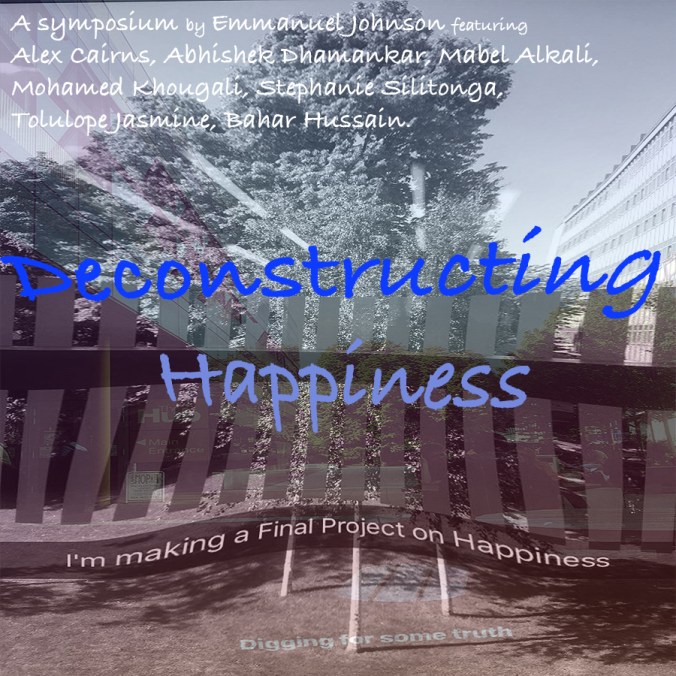
I gathered a group of intellectuals and thinkers, across cultures and disciplines to discuss happiness. I was interested in seeing how such vast and complex discourse could be perceived in several ways. This symposium was recorded as sound. Please see links below to listen:


Stream

Infusion of Light


  • Other Side of the Jordan
  • Cries of the Redeemed Sinner
  • Soul-tied
  • Why I call you Brother
  • Delivered


Other Side of the Jordan

Bright supernatural glory
brighter than the sun.
I dream of,
life above me.
I dream of,
the one.
The lakes and trees:
the great wonder
falls short, of
what He sees:
Miraculous yonder.
Transcending, earthly pleasures.
Matchless, to vain desires
exceeding, natural measures:
Haven of joyous martyrs.


Life, like no other,
I reconsider.
Human order?
I reason deeper.
Beyond,
my imagination, I find:
your nature, truly refined.
My understanding
feeble to comprehend,
the towering
splendour,
the beauty of the end.
The flesh, repels
strongly, against its gates.
within the wells,
salvation awaits.
Language fails.
What joyous miracle!
The falling of the scales,
the fire shall rekindle.


Water of meaning
baptised, I am, in fire.
Clothed,
In the warmth of your healing
my gracious messiah.
Afar, lies of existence,
embraced, I am, in truth.
Searching, for deeper essence
I find, no greater sooth.
The void, in my soul
I feel no longer.
I watch, unfold:
a garment; holy thunder.
To die; to live,
I must, to see.
The day, the eve
of you, and me.


Cries of the Redeemed Sinner

I have been freed
of evil grasps,
which intended to abuse,
and render me bound.
I wonder, in loud silence:
the outcome,
of the rest of days.
I contemplate
night and day,
how my sorrows:
in the dark,
shall be made, to joys:
in the light.


Proclivities, tingle
in agonising excitement.
I resist;
of resentful will.
I contemplate.
I contemplate.
I contemplate:
sorrows,
only for the dark.
I await:
the joys of the light.


Unaware, I was
of you,
by my side.
Friendly, constant companion.
How long,
have you been there?
All along,
Through the night and day,
He responds.
I am here,
to comfort you,
He exclaims.
And lead you,
on a glorious path:
to the joys of the light, to the joys of the light.


Soul-tied

A part of me, to share,
unleash the smile within.
Delivered from despair;
my life is worth living.
Never separated;
though we are apart,
a slice, dedicated
lies in your heart.
The truth, we hate,
feelings, we crave.
Longings, innate,
of mine, I gave.

Far or near,
our love runs deep.
I come to bear
with tears I weep.
The nights, we flew
our minds, in space.
A spark, who knew?
would light my face.
In you, I learnt,
to love my brother.
The times, we spent
will last forever.

The dreams we hold
so dear, today;
rise from, untold
pain, all the way.
To see again;
we swore, to fate.
We play, a game
of love, so great.
In time, we will
be whole again.
To sooth, and seal
the verge of bane.

Why I call you Brother

Desperation, swinging
The edge, I stand.
I’m not alone, you remind,
stretching out your hand.
Great journeys lie ahead,
our paths, deeply intertwined
again, I see, my friend
a love so deep, so kind.
No superficial spectacle,
no pleasure can deny,
the beasts we wrestle with:
dance together, tonight.
My brother,
my brother.
My brother!
Do you see what I see?
On this journey, we face
the same enemy!
Poisonous, but sweet.
Do not be seduced,
for if you are,
your feet
shall surely be bruised.


Tread the earth, you while
but Sisyphean, your search.
For if enticed, you mile,
glory, shall not emerge.
To break away:
you need,
to soar the hill ahead.
No longer
shall you heed
to voices in your head.
In time,
you shall arise
and dine, with worms in dirt.
To set alight,
the eyes:
to lift your smile and hurt.
Then,
shall you know and see
the joy of truth, within:
it sets,
the bound free.
To rest,
it leads you in.


I look,
in holy wonder:
new meaning
with my brother.
The journey, we sojourn
with him, I renew.
Contempt, we burn
to bloom, with You.
Alas, I slay
judgement, for I see,
the price, you pay
I shall, to guarantee;
a life, of peace
of love, I must lead,
to have, and squeeze
the vine, of the creed.


What shall we do?
Our road shall one day end
until then, you
shall be
a mirror and a friend.
In you, forever, shall reside
a light of truth, to fulfil.


Delivered

Showers of amity
to sheen the spirit.
The pressing on,
for things unseen.
Waves of faith,
for greater days,
on it, to surf
amidst the chains.
Closet, of the hurt,
the secret place of strength,
to drink, of the cup
the fullness of the throne.


Prisoner of hope
surely, it shall come.
Anchor of the light
brink of morning shine.
Many nights, in blissful silence
many days of peace.
In the bright, there lies a crown
to bind the truth within.
Farther than you dig,
in it, you shall find
a mild consuming fire
guarding through the times.


Legacy of Effiong,
the tree, shall one day yield.
The stairway of grace,
true power of the weak.
A wind, making whole,
priding in tenderness.
Capstone, looked down upon,
in him, shall ye be seen.
Grasses, held as gold
shall die, and be gone.
New wine, quickening,
the pain allows for joy.


Presentation [Short Film]

Screen Shot 2017-12-28 at 12.50.46

Peter, an upcoming fashion designer, is up for promotion and prepares a presentation – only to get to work and realize he’s left the hard drive containing his file at home. Will he be able to get it before it’s his turn?

Directed and Produced by Jemima Damina

Screenplay by Jesimiel Damina

Director of Photography – Emmanuel Johnson

Unit Production Manager – Marylyn Essang

Production Coordinator – Michael Umoudit

Production Designer – Jesimiel Damina

1st Assistant Camera – Choszer Bassey

2nd Assistant Camera – Richmond Kings

Key Grip – James Dandy

Sound – Wisdom Augustine

Wardrobe – Favour Dandy

Hair/Makeup – Abigail Umoudit, Ini-Iso Akpan

Craft Service – Mfon Williams

Happiness Research Journal V: Narrowing Down on Documentary Topic

At the moment, it has solidly been established that I want to explore the topic of happiness, whilst focusing on affect, and looking into the feeling of mutuality experienced by International students within small groups of collective interests. Nonetheless, I am struggling to pinpoint a narrow topic for the documentary that I intend to produce, which I hope captures the emotions I feel; as a member of the populace of international students.

My struggle is very much focused on the fact that, I have feelings and emotions which embody the focus of what I aim to produce. Every day as I go out and interact with international students, I experience these affects; very strong feelings of ‘togetherness’ which bind international students together and enable us function as a unit. However, I am unable to convert them into something denotable, which can be used in developing a message or narrative of some sort, needed for the picture I intend to capture in this project.

My strategy for tackling this obstacle thus far has been research. I have been reading into, and exploring the theory of ‘affect’, with hopes of gaining a better understanding of it, which I believe would make my journey a little less burdensome. Nonetheless, this is yet to provide me with the enlightenment that I seek.

My ‘search of meaning’ is exposing me to extensive frameworks of feelings; which are now generated during social encounters with international students from countries and cultures foreign to mine.

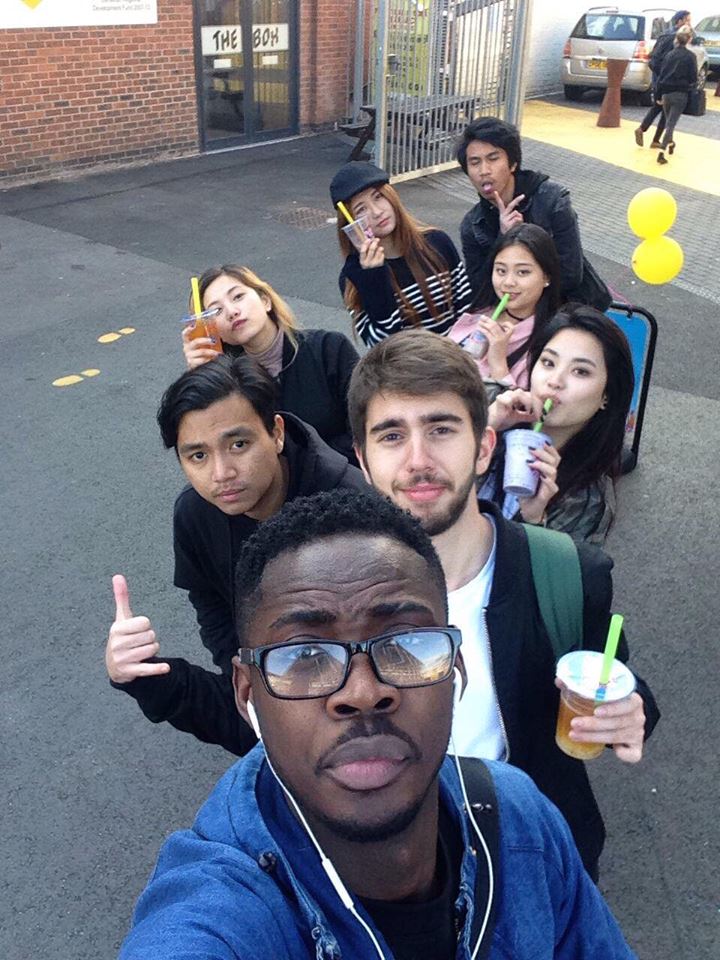
The so called ‘feeling of mutuality’ which I have touched on in previous posts is becoming manifest to me, even whilst socialising and ‘chilling’ with individuals from a different country (Indonesia), who speak Bahasa Indonesia which I do not understand. Nevertheless, I am able to experience similar feelings of togetherness as them, whilst under the same umbrella of vibrations created by the affective atmosphere of trust and intimacy built by these foreigners. This has me arriving at an epiphany and thinking to myself ‘wait a minute! You mean to tell me that, the feeling of mutuality isn’t experienced solely within national communities, but back and forth with international and vice-versa?’.

This highlights infinite potential experiences which other international students might have faced; crucial to my research but new to me still.

This complex experience leaves me with multiple questions, such as:

  • What does that experience really mean?
  • How is that affective experience even created?
  • Why do I share the same emotional attachment as them, although I do not understand the language that they speak, or their mannerisms and way of life?
  • Do other international students connect to umbrellas of vibration, generated by people from countries foreign to them?

I believe that, within these questions, I shall find solutions to many of the puzzles I have battled with, whilst deciding on my documentary topic. I also imagine that my findings shall heavily construct the focus and manner of approach I shall undertake henceforth, during this journey. Nevertheless, this is bound to be a life-changing and transformative experience, as I discover new knowledge in every text I type, emotion I feel, and encounter I experience.

Research Proposal: The Exploration of Happiness: Construction and Connections within the Populace of International Students in the United Kingdom

 Aims and Objectives

My research seeks to uncover the theme of happiness within the community of international students. With this project, I have the intention of achieving an understanding of mutual practises, which bind international communities together and underline seemingly ordinary routines. Frable (1997) indicates that identity is diverse and chaotic. This reality poses a crucial challenge for me, as I aim to unearth aspects of everyday practise that keep international students ‘going’ and make life bearable for us. Thus, altering our perceptions of ourselves and identity.

The reason behind this goal is the enormous meaning within the course, which envelopes traditions that constitute the totality of mutual connections in the community of international students. My remonstrance shall now be to deconstruct their identities and present them in a visually suitable manner on screen.

My focus is very much centred on the experiences and perhaps struggles of international students who are faced with the task of rediscovering their positions and identities in unfamiliar spaces.

This process encompasses a large volume of depth, which I believe at the moment is in the dark. I aspire to shed light on its dynamics, with hopes of drawing out enlightenment from non-internationals, on our plight behind the curtain.

Although this process has been ongoing for a long time. I am looking to critique current understandings of what it means for an international student to feel lost, due to his or her current environment, and subtleties of this reality.

As much as my project is focused on capturing the process of mutuality established by international students, as we try to make sense of our spaces; I intend to bring to light the emptiness felt by many of us, who try to build a life for ourselves abroad and far away from home. This is meant to correlate with the ethos behind the entire project – an imaginative piece, which reflects the continuous bustle of a group of individuals, faced with the objective of making sense out of their new-found realities.


Relevance to Professional or Academic Field

My project links to the overall framework of my professional and academic prospects for the future. Based on my interest in Media Production and Film, I intend to put my passion into use and work within this field in future. Henceforth, I have decided to make a documentary on the topic of happiness, and the connections that lie within the community of international students. This allows for me to express my passion for Media Production and produce film through it. Taking this route equips me further for challenges that I might face within the professional or corporate world.

My primary roles within this project shall be Director and Producer. I believe this shall present me with invaluable experience for the future, as it is my most ambitious project yet, and the one I have worked hardest at. Bazin nd (cited in Shaviro 2001) reflected upon his concept of ‘the myth of total cinema’ as he painted it as ‘a recreation of the world in its own image’. It is my goal for this project, as Director and Producer to recreate a reality, which can even sometimes be painful. This is what (Kotarba 1983: 15) describes as ‘a private, even lonely experience, as a feeling that I have that others cannot have, or as a feeling that others have that I myself cannot feel’. This project aims to capture the feelings international students go through, which non-internationals do not experience, and furthermore depict privileges that cannot be enjoyed by people foreign to particular demographics.

In addition to my professional field, which I have listed as Film and Media Production, the academic side of my identity is growing in relevance day-by-day. This makes it impossible to separate this aspect of my future from the other. As Matthew mentions; our identities are never stiff but always moving (2009: 36).

Although I identify as a Media Producer and Filmmaker, I also identify as a Cultural Thinker and life-long student of Cultural Studies. Therefore, I shall be using film as a tool of expression for this medium; highlighting my desired theories within it, including the most primary for my project; affect theory.

This research into happiness shall find itself at home to the body of knowledge within Cultural Studies. Ahmed in (Gregg and Seigworth 2000: 29) describes affect as ‘what sticks, or sustains or preserves the connection between ideas, values, and objects’. This quote highlights the very nature of mutuality that I have discovered from my observational analysis into the discourse of happiness within the community of international students. I aspire to deconstruct and expand upon this, and highlight meanings within those words. I aim to use this as a primary guide within my project, as I explore the concept of ‘connections’ within the populace of international students in the United Kingdom.

It shall permit for the embodiment of my identities and selves, and allow for me to find my voice, not only as a Filmmaker but also a member of the academic body of Cultural Studies.

My work shall contribute to already-existing research within an important aspect of this academic field, which is affect theory. The reason for its importance is existential to the fact that, affect and happiness and non-measurable tangents; stressing the need for further research and understanding on it.

Not only shall my work contribute to what already exists, it will also present a fresh perspective, reflective of my identity as a disciple of Cultural Studies, who also happens to produce visual media texts.

The words ‘passion’ and ‘passive’ are part of the same lineage, which connote ‘suffering’ in Latin (Ahmed 2014: 2). This is expressive of the fact that, although I am conveying my passion for Media Production and Cultural Studies via this final piece, I will face challenges whilst getting into the safe spaces of international students. Because of this, it is important that I am most comfortable with my passion in this project. This allows for me to direct the production in the right path, and allow for others to steer it to a constructive end.


Research Approach or Methodology

My work shall make use of auto-ethnography throughout the entirety of the production, as I undergo the process of lived cultural and personal experiences of international students within their own groups and demographics. I aim to capture the meaning behind being in a group, being part of something that matters, and the collective underpinnings which bind this mutual process.

I shall make use of interviews and focus groups, as a way of capturing the thoughts and opinions of my participants. My goal is to establish a rapport with my research subjects firstly, before going into filming. This is needed in creating a comfortable atmosphere of trust, which shall allow for better expression of selves within my project.

Auto-ethnographers are at will to use personal lived experience, in addition to their methodological literature gained from research, in hopes of representing their researched culture as familiar to the masses (Ronai, 1995, 1996 in Ellis, Adams and Bochner 2011). As a fellow international student who finds solace within smaller groups of common interests, I shall also be contributing towards the final output of the project, due to similarity of experiences with my participants.

I am looking to explore two genres of documentaries within this project:

  • Participatory
  • Performative

I believe this works accordingly with my auto-ethnographic approach, because, although I may not be the central point of focus within the film, I shall have an influence on the turnout of its narrative, both visually and auditory.

I intend to adopt, but not replicate Michael Moor’s approach, particularly in his 2002 documentary; ‘Bowling for Columbine’. This is predominantly because the documentary does not appear ‘scripted’, as its narrative seems to deviate from a set of ‘stiff’ rules, and is fluid and experimental in approach. This gives room for more expression from crew and cast.

I aim to question how happiness is constructed within the populace of international students in the United Kingdom. As a result, I shall be engaging in participatory observation as a way gaining an understanding into reasons why subgroups are created within the international student community, and whether mutuality is achieved through them.


Expected Outcomes

It is my desire to create an understanding of the complexities we as international students face away from our home countries, whilst chasing a degree abroad. This connotes struggles of identities in the sense that, they become subject to a high degree of change – which often leads to a less-understood and more confused interpretation of who we think we are, and how we see ourselves in the long run.

Through my background in Communication, Culture and Media, I hope to affect the way international students are perceived by both higher institutions of learning, and natives of the country. I look to attain this by highlighting certain unseen experiences, which help us get by in everyday life and give us a reason to hope on something greater in future.

Through my engagement with auto-ethnography, I will arrive at a clearer understanding of the meaning behind mutual practises between international students, which help to create connections amongst individuals. This shall also provide an avenue for fellow international students to communicate their feelings in an unconventional manner.

It is my hope that, adjustments can be made in the way international students are orientated upon arrival in the United Kingdom, and certain support mechanisms can be put into place to support students who now think of themselves differently, because of exposure to foreign values placed on them via learning, and lived experience within society.


Bibliography

 Ahmed, S. (2014) The Cultural Politics of Emotion. Edinburgh: Edinburgh University Press.

Ellis, C., Adams, T., Bochner, A. (2011) ‘Autoethnography: An Overview’. Volume 12, No. 1, Art. 10. Available at <http://www.qualitative-research.net/index.php/fqs/article/view/1589/3095#g2> [11 July 2017].

Frable, D. (1997) ‘Gender, Racial, Ethnic, Sexual, and Class Identities’. Annual Review of Psychology, Vol. 48. Available at <http://maxweber.hunter.cuny.edu/pub/eres/SOC217_PIMENTEL/frable.pdf> [11th July 2017].

Gregg, M., Seigworth, G. (2010) The Affect Theory Reader. Durham: Duke University Press.

Kotarba, A. (1983) Chronic Pain: Its Social Dimensions. Beverly Hills: Sage.

Matthew, K. (2009) Heidegger and Happiness. London: Bloomsbury Publishing.

Shaviro, S. (2001) ‘The Cinema of Absence: How Film Achieves a Greater Reality by Showing Us What Isn’t There’. Film Supplement: The Periphery. Available at <http://www.thestranger.com/seattle/Content?oid=7939> [11th July 2017].


Literature Review – Final Project

The concept of happiness is one that I have always been fascinated by. Working on the topic for my final project, I started off wanting to research on depression. I experienced a change of thought after deep reflection into the things I actually cared about and hoped to get out of the project.

I am deciding to make a documentary; looking into the discourse of happiness within the community of International students here at Coventry. I aim to explore connections; ways in which international students find happiness in a foreign environment.

For this research project, I have identified four media texts, which I believe could be useful to my work.

The first on my list is The Promise of Happiness by Sara Ahmed. This book looks into the construction of happiness and critiques contemporary perceptions of it. This would be relevant to my work, as I look to follow a similar path by questioning already-existing understandings of happiness by people; particularly members of the international community.

The film, Hector and the Search for Happiness is one that I have found relevant to my project, as it captures the journey individuals sometimes have to undergo in order to discover meaning. My project too is inspired by a journey and search I went on, leading me to the current location that I am in at the moment.

The third media text of relevance to my work is The Psychology of Happiness: A Good Human Life by Samuel Franklin. This book incorporates theory and research in expanding on the understanding of what it means to be happy.

In the film, ‘The Pursuit of Happyness’, the attainment of it is represented in a exciting manner. I shall be exploring within in this piece, Gabriel Muccino’s approach on happiness in the film and its relevance to my project.

In her first chapter, Ahmed starts off by questioning the construction and perception of happiness. She defines it as ‘the drama of contingency’ (2010: 22). A future situation which is possible but uncertain typifies my experience with happiness. This is something I hope to explore in my final project.

This book chapter makes it clear to me that, the ‘definition’ of happiness has already been looked into. Although it touches on aspects of affects, the book chapter seems to address happiness from an individualistic perspective and not collective; thus, neglecting the role of emotional connections within communities. This is not to suggest that happiness relies solely on mutual connections, but to underpin its importance within society. Hyman (2004: 87) highlights that, multiple people see happiness as ‘something individual, internal and self-oriented’. This, to my understanding denotes that, happiness is created internally, but creates a vibration – an atmosphere for others to partake of.

Hector’s Search for Happiness stirs up an important discourse of identity within happiness, and the role it plays therein. This film illustrates a rather western perception of touring the world in order to discover happiness. Correspondingly, Giorgino (2014: 9) argues that, ‘greater happiness can be achieved by having a greater understanding of the world and oneself’.

Whilst in the pursuit of happiness, it makes me question whether or not I would be required to follow in similar suit. Whether or not International students who have left home to study in a multicultural nation like the United Kingdom, and are still unhappy are getting the theory wrong. This takes me back to Ahmed’s concept; ‘the drama of contingency’, which in this case reflects the fact that, although an individual travels around the world or is situated in an international environment, he or she may not achieve greater understanding or happiness.

This is reflective of the experience of some international students, of whom I have been in contact with. Although many of them have broadened their understanding of international cultures, and learnt tremendously about other ways of life, they still experience a sense of emptiness within – even after returning to their home countries.

This takes me to the discourse of identity within happiness. As seen in this film, during Hector’s journey towards happiness, he went through a period of self-discovery; which could be translated as the uncovering or breakthrough of one’s identity. He only achieved happiness after this process. This leads me to question what it means to ‘be’, as our identities are never static but always in motion (Matthew 2009: 36). If I am to embark on a similar journey of ‘being’ or ‘becoming’, would that guarantee my happiness at the end of the tunnel? And when do I become aware of how close or far I am to the finish line? Moreover, does this journey even have a stopping point? Based on these thoughts, I disagree with the simplification of the pursuit of happiness, which this film seemingly portrays.

Identity is varied and complex (Frable 1997). In relation to my project, I am discovering that, many international students live chaotic identities. Upon returning to our home countries, many of us struggle to fit back in and feel like totally different individuals. This creates extra difficulties in our pursuit, as establishing connections with people now becomes burdensome.

Christopher (1991: 149) cited in Zevnik (2014: 19) highlights that, the ideology and moral visions of non-western individuals must be taken into consideration, in order to avoid psychological segregation. This is relative to the notion this film sends out. It surely is more convenient for a white heterosexual male to travel around the world, having the backing of multiple privileges. But what happens to many of us who do not share the same freedoms? Surely, reality must be a lot grittier than portrayed in his perspective. This is a major aspect the film failed to take into consideration.

In The Psychology of Happiness: A Good Human Life, the topic of happiness is approached from a conscious perspective, in hopes of gaining insight into the ways people think about and understand happiness. Franklin writes on the meaning of ‘the good human life’, and describes it as something of deeper understanding and moral significance (2009: 158). He furthermore states that, ‘The key to happiness is found in virtue because courage, temperance, justice, friendship, and the like, allow us to acquire the real goods we need to fulfil potentials’ (Ibid 2009: 158).

My major highlight within the chapter ‘Contemplation: A Different Kind of Happiness’ is that, it provides ‘working solutions’ within it. Applying Franklin’s keys to my research project produces distinctive results. I would admit that, there is a level of truth in his listed keys, as many international students that I know have identified ‘happiness’ within friendship, and the virtue it brings.

Nonetheless, I would argue that, although a life of high moral standards might produce a sense of fulfilment within the individual, it does not always lead the pursuant towards happiness. This raises the question ‘how do you define happiness’. Maybe fulfilment really does equate happiness, but in this context, I would like to define it as a long lasting feeling of tranquillity and peace.

Franklin (2009: 158-159) discusses Aristotle’s perspective on happiness, as he mentions that, true happiness is embedded within contemplation, and it is this process that guides us to ‘the world of knowledge, truth, perfection, and God’ (Ibid 2009: 158-159). This takes us into deeper realms of understanding around affects of happiness. Aspects which I believe shall be crucial for my research, as many international students look up to the guidance of a higher power, whilst in pursuit of happiness and meaning in life.

The subject of fulfilment within happiness is demonstrated in the film: The Pursuit of Happyness. Muccino makes a good attempt at capturing the reality many individuals go through while chasing their dreams and ambitions. In comparison to Peter Chelsom’s Hector’s Search for Happiness, Muccino documents the struggles involved in chasing happiness, whilst surrounded by pressing demands all around.

This relates to my research because of its resemblance to the happenings within real life. Many international students believe the odds are not in our favour, as we often have to work harder than others to get certain jobs or opportunities. With my final project, I aim to be as reflective as possible, and document things as they actually are.

This film captures the isolation that Chris Gardner goes through whilst in his pusuit of happiness, and the loneliness that many international students often experience. The topic of alienation is one that I intend to focus on within this project, as I look into the frequent feeling of seclution experienced by international students as they try to settle into a foreign environment. Martin (2008) cited in Fave (2013: 4) points out that, the subjective assessment of happiness changes over time, based on life experiences and development undergone by a person overtime. This stresses the neverending subjectivity within happiness, and how it might never gain a complete measurement, because of the unceasing factors that come into play.

The film questions the position of happiness within society; our understanding of its meaning and location. Chris is represented as an individual who finds happiness in always being there for his son, irrespective of the challenges he faces. The location of happiness in this context, is rooted in reason and purpose. Although surrounded by difficulties, Chris has identified a purpose in life and has a reason to get up every morning and face his challenges. This reveals a new aspect within my research; the role of purpose within happiness. The feeling of purpose affects the happiness of individuals in means that need be accounted for (Dolan 1968: 11).

Adopting this into my research, I aim to look at the various means that, international students use in accessing happiness. Be it, a purpose in life or the pursuit of fulfilment.

Bauman (2000) discusses the theory of ‘The Liquid Modernity’ where he comments that fluids do not maintain a given shape but constantly take multiple forms. This can also be said about the identity of international students and the nature of happiness too. Through this project, I shall be looking to explore this theory, assessing the the complications involved in this process.

As change is the only notable constant within happiness, what implications does this now have on our identities? International students are having to forsake the shape we have taken all of our lives and adopt new ones, in order to fit into the society we find ourselves in.

In order to find happiness in an environment foreign to us, we are having to implement new practises, lifestyles and traditions; changing the way we understand ourselves and the society around us. At the end of the day, what do these all boil down to produce? This is what I shall be addressing in my documentary research.


Bibliography


Ahmed, S. (2010) The Promise of Happiness. Durham: Duke University Press.


Bauman, Z. (2000) Liquid Modernity. Cambridge: Polity Press.


Dolan, P. (1968) Happiness by Design: Finding Pleasure and Purpose in Everyday Life. London: Penguin Books.


Fave, A. (2013) The Exploration of Happiness: Present and Future Perspectives. New York: Springer.

Frable, D. (1997) ‘Gender, Racial, Ethnic, Sexual, and Class Identities’. Annual Review of Psychology, Vol. 48. Available at <http://maxweber.hunter.cuny.edu/pub/eres/SOC217_PIMENTEL/frable.pdf> [20th June 2017].

Franklin, S. (2009) The Psychology of Happiness: A Good Human Life. Cambridge: Cambridge University Press.


Giorgino, V. (2014) The Pursuit of Happiness and the Traditions of Wisdom. Turin: Springer.


Hyman, L. (2004) Happiness: Understandings, Narratives and Discourses. Basingstone: Palgrave Macmillan.


Matthew, K. (2009) Heidegger and Happiness. London: Bloomsbury Publishing.

Zevnik, L. (2014) Critical Perspectives in Happiness Research: The Birth of Modern Happiness. New York: Springer.

Realism

Check out my 30 second film. This film uses all of Einsenstien’s 5 montages in an attempt to depict reality.

Starring Jonathan Napitupulu and Mabel Alkali.

Directed and Produced by Emmanuel Johnson and Stephanie Silitonga

Filmed by Emmanuel Johnson

Edited by Jonathan Napitupulu, Stephanie Silitonga and Emmanuel Johnson


Happiness Research Journal IV: International Students > Urban Culture

My research process has seen my focus transition from an extremely broad perception of happiness to a more narrowed down view.

I have been speaking to people and researching on the topic of happiness, in hopes of gaining a stronger understanding of what I truly desire to achieve with this project. The discourse of Urban Culture, compared to the way of life of International Students is not something I can say I truly care about. Perhaps, my primary reasons for intending to work on Urban Culture were heavily external and not truly from within. This is because, although I find this culture exciting, I hardly identify with it or share some sort of emotional attachment thereof.

19389528_1354006271303873_1547496488_n

On Wednesday (14th June 2017), we were told to speak to each other and discuss the ideas that we had for our final projects. My classmate, Nok, helped me realise my position in my research.

I have been an international student for about 5 years now, and have felt a strong connection with this community all along. With this in mind, I am looking to explore happiness within the ‘community of International students’. I am hoping to discover how happiness is constructed within the International populace, and look into how mutual connections are developed within it.

I believe my project shall be of benefit to International students within the UK, and Home students looking to learn about our ways of life; specifically in Coventry.

I have friends from other countries who sometimes tell me they feel empty and/or miss home. The topic of alienation is something very important within the international community. I aim to expand on this and find out the strategies current international students take in overcoming this challenge. Far away from their countries of origin, how do International students find happiness and connection in a foreign land, despite the challenge of isolation and alienation that they face? This shall be the focus of my research from now henceforth.

19389548_1354006267970540_1774283401_n

Happiness Research Journal III: Urban Culture

Working on my #Happiness project overtime has provided me with some clarity and insight overtime. Since my project is vastly broad, I’ve had to put in a lot of time, effort and research into narrowing down and producing something interesting still.

I brought a group of thinkers together last week to discuss ‘Happiness’. Together, we looked at its construction, meaning and position within society. This helped broaden my horizon, and enabled me think about other aspects of this topic that I hadn’t thought of in the past.

At the moment, I am looking at researching into the construction of Happiness within Urban Culture.

Within this project, I aim to create a space where people would be able to rethink their positions in the world, and maybe view life, practises and interests in a new light.

So why Urban Culture? I am fascinated by the energy, excitement and discovery that it brings. These are elements which I personally associate with Happiness.

I look around and see people living carefree. I speak to them and discuss their interests and experiences. I notice diversity, and am excited by the distinction gained from their respective lives. I am intrigued by the difference within Urban Culture and how these seemingly different characteristics come together under a common umbrella.

I intend to create a documentary about it. At the moment, I am using the Netflix documentary; Hip-Hop Evolution as a reference for the future. I aim to imitate its montage and style of production.

Within this narrowing down process, I am questioning: ‘what is this mutual form of happiness and understanding that connects these individuals with each other, and how is it created?’. I am also looking to discover whether or not there is a form of happiness to start with.

Looking at the relevance of this subculture within society, I have noticed its tentacles spread across all aspects of society. There is a reason why Hilary Clinton attempted to dab during her electoral campaign, and furthermore got Jay Z and Beyonce to back her in her campaign. These acts highlight the importance of Urban Culture within society, and why ‘elite’ members of the society would go out of their way to identify with the ‘ordinary’, and their practises.

As this Sub-Culture itself is diverse, my main focus shall be centred around its music scene. This medium acts as a major agent in the spread of this culture, and propagates the practises and beliefs within. Nevertheless, I aim to throw myself into the field of Urban Culture by being part of its gatherings. This will provide myself with more perspective into its ethos and lifestyle.

My position within this research has never been stagnant, but progressive, as I started off wanting to work on Depression, to ‘Happiness’, and now Happiness within Urban Culture. I expect even bigger changes within upcoming weeks, as I am still researching, speaking to people and seeking visual references.